


 Written by Shlomit Malka
10/07/2026
5 min
Independent, Not Alone
For a few days I was convinced there was a hive inside my thyme plant. What I found instead changed…

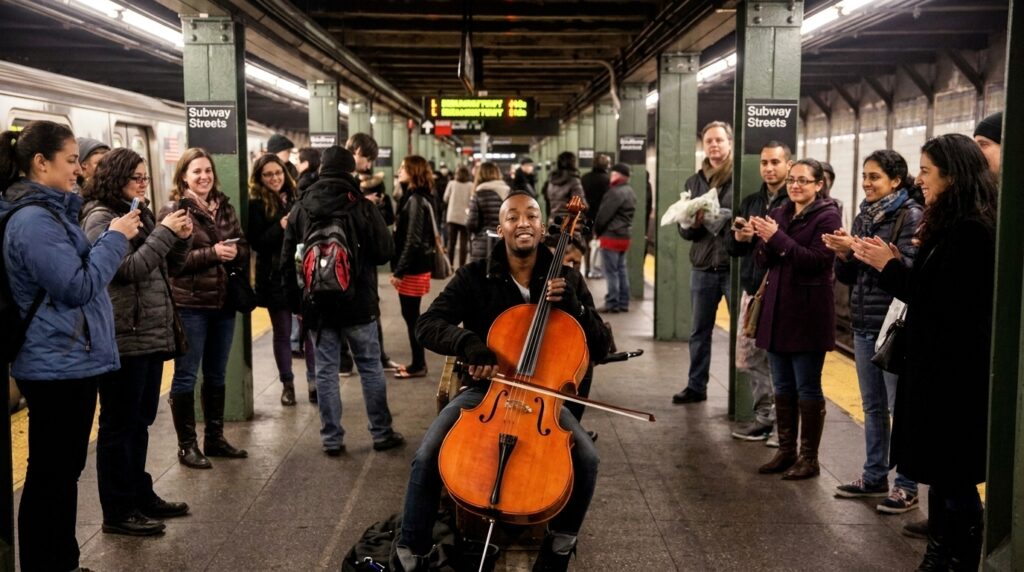
Last week I was waiting for the L train at Williamsburg. The platform was the usual kind of crowded – everyone sealed inside their own atmosphere, phone out, earbuds in, that familiar unspoken agreement to be alone together.
Then I heard the guitar.
A man was playing at the far end of the platform. Not background music. Not the kind of busking that sits just below your attention. He was fully, almost unsettlingly in it – fingers moving with the fluency that only comes from years of private practice, eyes closed in places, completely unbothered by the crowd or the noise or the trains.
I stood there. Then the person next to me stopped scrolling. Then someone else. Then, slowly, the whole corner of the platform just… settled.
The train was late. We had about ten minutes. And we all just stood there and listened. Together.
When the train finally pulled in, everyone applauded. People got on. And I looked around and realized something that stopped me completely: everybody was talking to each other. Strangers.
The people who had arrived wrapped in their own private silence were now laughing, making eye contact, having actual conversations. The warm, slightly surprised energy of people who had just shared something they hadn’t expected to share.
I stood in that train car and couldn’t stop thinking about what had just happened.
We talk about the creator economy in terms of content. Views, reach, engagement, monetization. We talk about output and optimization and audience growth. And those conversations aren’t wrong – they’re just incomplete.
He didn’t create content. He created a condition. A moment where a group of strangers had permission to be human together.
That is what art does. Not entertain, though it does that, but interrupt. It breaks the sealed loop of individual distraction and opens a space where genuine presence becomes possible. Where you remember, briefly, that you are a person among people.
No algorithm replicates that. No recommendation engine creates the conditions for a stranger to turn to you on a subway platform and say, wasn’t that something?
We tend to talk about creative work as a category of culture – something that enriches life, adds meaning, makes the world more interesting. All of that is true. But I think it misses what was actually happening on that platform.
Creative work is one of the last reliable ways humans manufacture shared presence in a world that has become very good at keeping us separate.
Creative work isn’t an addition to human life. In the most literal sense, it’s a mechanism for it. It’s one of the few things that reliably breaks people out of their private loops and puts them in contact with each other – not through obligation or small talk, but through something genuine and shared.
Here’s the part that kept coming back to me on the ride home.
The man on that platform was extraordinary at something. Not in the viral sense – in the real sense. Years of work, years of showing up and playing whether anyone was listening, years of developing the kind of fluency and presence that you cannot fake and cannot shortcut. He had given his time and attention to something that the world mostly treats as a gamble.
And I found myself wondering, the way I often do with people like him: Is he okay? Is he able to sustain this? Does the world make enough room for someone to keep doing what he does?
I don’t know the answer for him specifically. But I know the answer in general is: not easily. And that has a cost that goes far beyond the individual. Every time someone with that kind of gift has to stop – because the economics didn’t hold, because the admin became too heavy, because the risk finally outweighed the return – something disappears from the world. Not just a career. A source.
A source of the kind of moments that turn a platform full of strangers into something briefly, genuinely human.
I’ve been building things for and alongside independent creative professionals for a while now. And I’ve noticed that the people doing the most meaningful work often have the hardest time articulating why it matters. Not because they don’t feel it – they do, deeply – but because the language we have for creative value is mostly commercial. Reach. Output. ROI.
None of that language fits what happened on that platform.
What fits is this: when creative work is done with real presence and real craft, it creates conditions. Not content. Conditions. Conditions where people can briefly stop performing their separateness and feel something together. Where a stranger becomes a person. Where a crowded, distracted platform becomes, for ten minutes, a room full of humans who are glad to be alive at the same time.
That’s what I think about when I think about why any of this matters. Not the metrics. The moments. The man on the platform didn’t know he was going to do that. He just played.
But that’s the thing about showing up with your full attention. You give people something they didn’t know they were waiting for.
Presence, not content
A musician playing at a subway station gave a crowd of strangers permission to be present together - and for ten minutes, everyone was.
The thing algorithms can't replicate
Creative work at its best doesn't just entertain - it interrupts. It breaks the sealed loop of individual distraction and opens a space for genuine shared presence.
Not just a career - a source
Every time someone with that kind of gift has to stop - because the economics didn't hold - something disappears from the world that goes far beyond the individual.
 Written by